PinchukArtCentre presents new exhibitions “Joy” and “Without Asking Permission”
On March 27, PinchukArtCentre unveils two new exhibitions: the large-scale group project “Joy,” in which Ukrainian and international artists explore one of the most essential emotions that gives us strength in difficult times, and the Research Platform exhibition “Without Asking Permission,” focused on works by Ukrainian artists from 2004 to 2014 who explored the theme of corporeality.
“Joy” (27.03.2026 — 30.08.2026)
Curators: Björn Geldhof, artistic director at the PinchukArtCentre, and Oleksandra Pogrebnyak, curator at the PinchukArtCentre
Artists: Kateryna Aliinyk, Lesia Vasylchenko, Ryan Gander, Tacita Dean, Anna Zvyagintseva, Alevtina Kakhidze, Pavlo Kovach, Katya Lesiv, Kateryna Lysovenko, Iryna Loskot, Simone Post, Ashfika Rahman, Daniel Turner, Tamara Turliun, Álvaro Urbano, Roman Khimei & Yarema Malashchuk, Julian Charrière.
Participants of the interviews: Oleksandr Androshchuk, Oleksandra Bezsmertna, Ksenia “Burevii”, Julia “Fobia”, Viacheslav Kaistro, Maiia Moskvych, Nazar “Reagan”, Alla Senchenko, Kseniia Shyian, Serhii Stratichuk, Oleksii Vasyliuk, Yaroslav Yaroshenko.
The exhibition “Joy” began with an urge to start a conversation about what sustains Ukrainians today, how many forms joy can take in times of war, and how it becomes a driving force — one that unites us, sustains us, and keeps our sense of self and will to live intact.
The starting point of the project was a series of written testimonies collected by Ukrainian veteran and marine Hlib Stryzhko. He conducted interviews with service members, veterans—both men and women—of the Armed Forces of Ukraine to learn what brings them joy and how they experience it today. Their stories become a disruptive agent, anchoring fragments of reality into the exhibition. Against the violence saturating our time, it offers joy and the sharing of joy as a radical act of humanity. Architect and artist Bogdana Kosmina transformed these texts into spatial objects that are just as significant within the exhibition as the works of the invited artists.
The exhibition invites visitors on a journey through the art center, provokes reflections, and presents different kinds of joy — from the playful, sincere delight sparked by an installation by Dutch artist Simone Post, created from candy and marshmallows, to the tender, poignant joy of Ukraine’s present in works by Kateryna Lysovenko, Kateryna Aliinyk, and Iryna Loskot.
Alevtina Kakhidze will set up a tattoo salon within the walls of the PinchukArtCentre, offering visitors the chance to literally “place joy under the skin.” Those who wish to do so will be able to get a tattoo based on Alevtyna Kakhidze’s drawings, marking an important period in their lives and their own courage. The images created by the artist carry special meaning. For example, one of the pieces depicts a saxifraga flower that grows through stone in the mountains of Crimea, and this tattoo becomes a symbol of unbreakable resistance and a long-awaited return.
The project aims to bring attention to the moments that make us feel alive and affirm our human spirit even in the hardest times. It also shows the international community that today joy is something Ukrainian society leans on — an experience others can learn from.
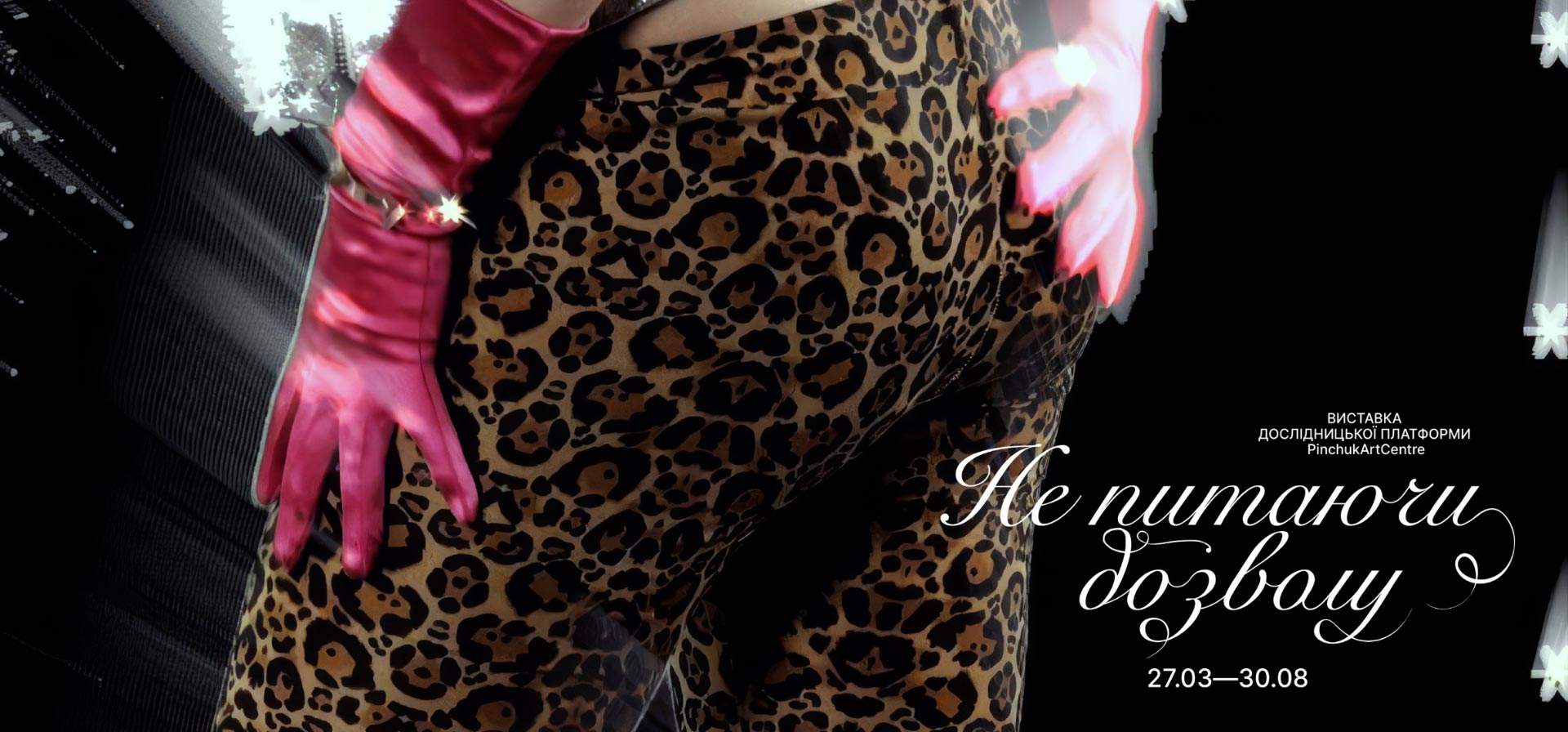
“Without Asking Permission” (27 March 2026 — 30 August 2026)
Curator: Daria Shevtsova, curator of the PinchukArtCentre Research Platform
Artists: Piotr Armianovski, Yevheniia Belorusets, Anatoliy Belov, Myroslav Vaida, Danylo Halkin, Anna Zvyagintseva, Taras Kammenoy, Alevtina Kakhidze, Alina Kleitman, Maria Kulikovska, Sasha Kurmaz, Serhii Melnychenko, Mykola Ridnyi, Lesia Khomenko, SOSka group (Hanna Kriventsova, Serhiy Popov, Mykola Ridnyi).
The Research Platform exhibition “Without Asking Permission” brings together works by Ukrainian artists created in the period between two revolutions — from 2004 to 2014 — in which the body emerges as a tool of self-determination and resistance. As civil society emerged during a time of major political change, artists began to speak more openly about personal and collective responsibility.
Artists took their work into the streets and squares to test its power, as protests had turned public space into a platform for society’s voice. Thus, in the performance How Long Can One Keep Screaming?, Piotr Armianovski makes his voice and body a form of direct resistance, speaking out against rising corruption and the pro-Russian reforms of President Viktor Yanukovych; meanwhile, Mykola Ridnyi stages an action outside the German Embassy in Kyiv, calling for simpler bureaucratic procedures for obtaining a Schengen visa. In her work Cage, Anna Zvyagintseva addresses political abuses of the legal system — both the persecution of individual artists and the unresolved cases related to the Maidan.
Artists rethink established ideas of the body shaped by post-Soviet morality, culture, and patriarchal values. Breaking down stereotypes of the “normal” body — attractive, heteronormative, and controlled — they instead turn to bodies that are real, vulnerable, and imperfect. Lesia Khomenko engages with the everyday experience of women’s labour; Alevtyna Kakhidze explores the social mechanisms through which identity is formed; and Alina Kleitman radically rethinks the stereotypes and clichés imposed on women.
While many 1990s artists focused on breaking moral taboos, artists of this period looked at the body and sexuality more carefully and in depth. In the series A Room of One’s Own, Yevheniia Belorusets documents the lives of LGBTQIA+ people and queer families, while Anatolii Bielov’s The Most Pornographic Book in the World opens up space for a conversation about different forms of intimacy and sexual self-expression.
The exhibition “Without Asking Permission” shows how artists explored the theme of corporeality in response to transformations in Ukrainian society that occurred during the Orange Revolution and the Revolution of Dignity. By advocating for equal rights and the importance of personal freedoms, they expanded the boundaries of perception and created new opportunities for future generations of Ukrainian artists. This period affirmed the importance of community-building, which enabled direct influence on political and social processes. It was through these horizontal networks that the strength of civil society gradually emerged.
The theme of Ukrainian art of the 2000s will be explored in greater detail in the forthcoming publication “Art Between Two Revolutions 2004–2014,” which the Research Platform has been working on over the past year. The book offers a broader perspective on this period, examining it through the lens of artistic processes as well as social and cultural transformations. The publication is being prepared by members of the PinchukArtCentre Research Platform: Yevheniia Butsykina, Tetiana Zhmurko, Oleksandra Mykhailenko, Milena Khomchenko, Kateryna Tsyhykalo, and Oksana Chornobrova.