PinchukArtCentre presents a new exhibition “Self-Employed”
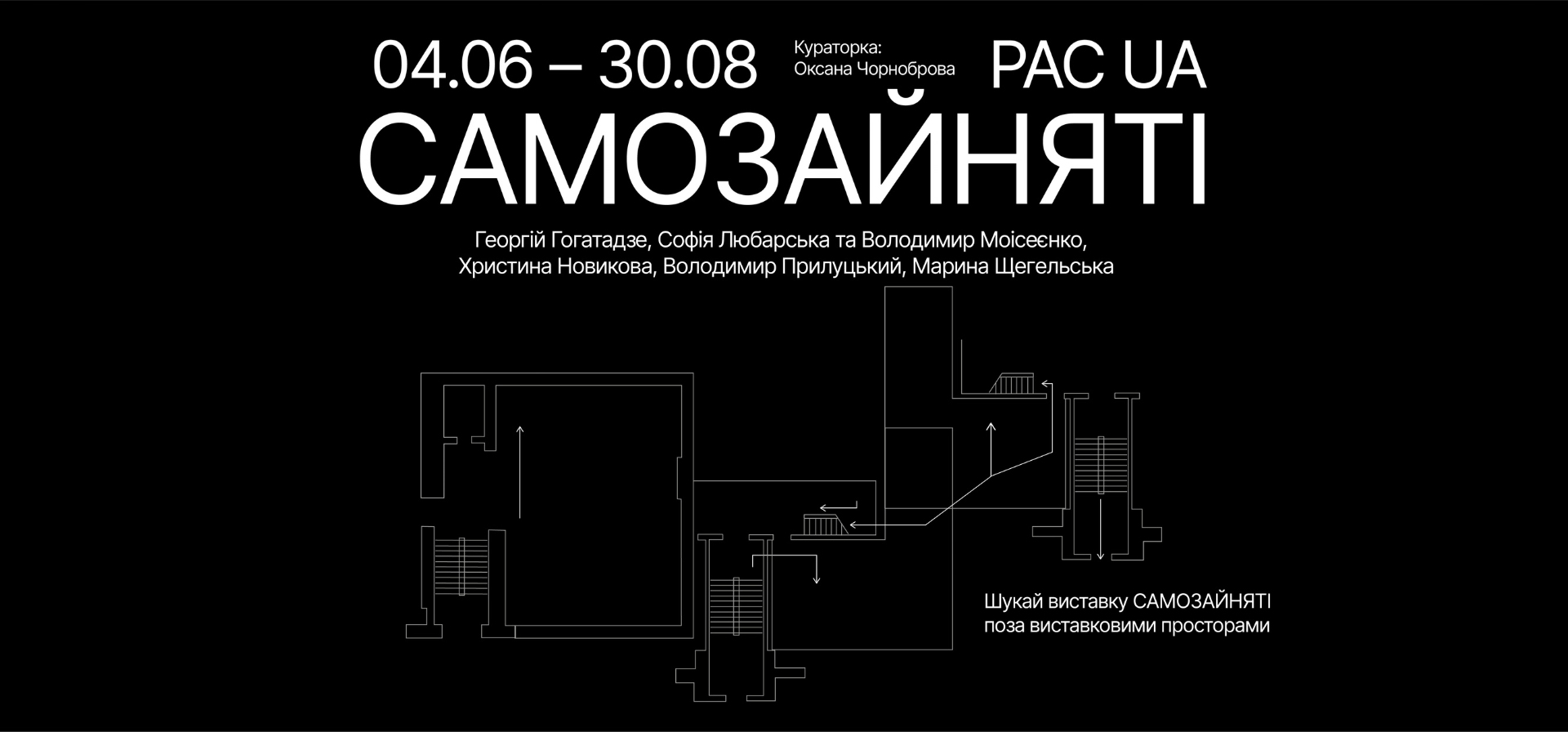
On June 4, the PinchukArtCentre presented a new project, Self‑Employed, curated by Oksana Chornobrova. For this project, the art centre has invited 6 Ukrainian emerging Ukrainian artists who have never worked with us before to show their works outside the usual exhibition spaces in PinchukArtCentre. By doing so, it opened itself up to real artistic experiments by artists who have little or no institutional experience before this project.
“Young (whatever that might mean) artists in Ukraine often exist as self‑employed and ungovernable. The word ‘homeless’ would also fit here: during the preparation of the exhibition, the State Migration Service issued an order to leave the building of the Institute of Automation, where the studios of dozens of artists were located, including some of the project’s participants. In the same period, on 24 May, there was a massive missile attack on Kyiv that damaged nine cultural institutions, including the National Art Museum of Ukraine. Exhibitions are not being created in the sterile white walls of galleries (the white cube), but in stairwells and kitchens. Works may be assembled from makeshift materials, and artists may have to earn a living elsewhere to support their practice — from assembling drones and teaching to monetising erotic content or working in an office of an IT company. On the one hand, this suspended state speaks to a desire to isolate oneself from the outside world with all its chaos and cruelty, and to create a private utopia in one’s flat or in an abandoned factory. On the other hand, it is an impulse to speak about problems and touch on uncomfortable topics, and therefore to create comfortable conditions for oneself independently.
This is a unique moment of artistic formation, because although it is accompanied by extreme vulnerability, at the same time it allows for a certain freedom of manoeuvre. An artist who does not respond to state, social, commercial or institutional demands risks not receiving the recognition and privileges guaranteed by the system. At the same time, it is precisely this distance from established expectations of what ‘good contemporary art’ should be that leaves more space for experimentation and for seeking new artistic forms, which is ultimately what drives art forward.”
Within the framework of the “Self‑Employed” project, the artists were able to create new works that have been placed on the shelves, stairs, in the niches and in the storage room of the art centre. In the curator’s view, this underscores the particular position of the invited artists on the periphery of the public field of vision and of the “white cube”.
“This is a unique moment of artistic formation, because although it is accompanied by extreme vulnerability, at the same time it allows for a certain freedom of manoeuvre. An artist who does not respond to state, social, commercial or institutional demands risks not receiving the recognition and privileges guaranteed by the system. At the same time, it is precisely this distance from established expectations of what ‘good contemporary art’ should be that leaves more space for experimentation and for seeking new artistic forms, which is ultimately what drives art forward,” — adds Oksana Chornobrova.
The installation “By Day, My Castle Is Empty” by Hristina Novykova introduces viewers to the world of Lafa and Vika — a couple who have chosen an unconventional way of life that may appear “marginal.” The cramped space of the PinchukArtCentre storage room underscores how rarely people like them are represented in mainstream visual culture.
Heorhii Hohatadze’s “Work” is an extended performative act in which the artist creates and monetises erotic content. A QR code leads to a page where the author uploads photos and videos recorded over the course of the exhibition. At the same time, Volodymyr Prylutskyi, with his project “Samum (سموم),” creates an absurd situation by bringing the bustling life of Bessarabska Square into the art centre. From the neighbouring “Dubai” restaurant, a belly dancer enters the institution’s building. She dances in the spaces of the art centre, including the exhibitions “Joy” and “Without Asking Permission,” all of which is captured by CCTV cameras.
Maryna Shchehelska’s project “[][][][][][][][] [][][] [][][][][][][][][][][][] (unsupported font)” teases the viewer, generating tension between revelation and concealment. On both sides of the staircase, the artist installs doors that look as if they have always been part of the art centre. Behind them, she places a series of objects: small sculptures, a pair of binoculars with blurred lenses, a fogged-up transparent box, and a book whose pages barely turn. This creates an interaction dense with contradictions: on the one hand, the work intrigues; on the other, it resists being fully seen or understood.
In the work “Delays and Overdue Stages of Development” by Sofia Lyubarska and Volodymyr Moiseenko, the organic and the artificial, decay and regeneration, vulnerability and aggression coexist or even co‑depend. They work with images of beings subjected to pressure and transformation. The composition resembles a laboratory experiment in which existence is examined more as a paradox than as a regularity.
The artists in the exhibition “Self‑Employed” reflect on whether the very fact of presenting their work in an institution changes its status, and how this affects their relationship with the viewer.
As Andrea Fraser has pointed out, the institution resides in the notions, desires and relationships of art professionals, and not only in buildings or walls. Thus, it is possible to stage a “proper” exhibition even in an apartment, one that does not challenge the established understanding of contemporary art. But is it possible to create truly experimental art within the walls of an art centre? “Self‑Employed” offers its own answers.
The exhibition can be visited until 30 August 2026, as well as the PinchukArtCentre projects “Joy” and “Without Asking Permission.”