
Wendimagegn Belete
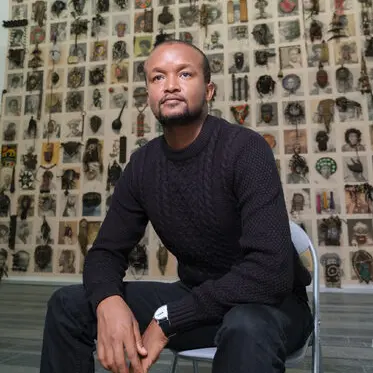
Wendimagegn Belete’s installation for the Future Generation Art Prize 2021 continues his exploration into questions on how history, memory, and identity are formed and constituted, and the concept of epigenetic inheritance, a memory that transfers over generations.
In the form of a large-scale mural, the work includes archival portraits taken during the second Italo-Ethiopian war (1935-1941). Ethiopia not only survived the invasion and won the struggle, but as a result it was honored as a country that was never colonized when the pan-African movement adopted the color scheme of Ethiopia’s historical flag. Collected from the digital archives, the photographs are conspicuously missing information about the depicted figures, a feature that highlights the risk of the individuals losing connection with their context and fading from collective consciousness. The work attempts to not only capture the memory of the person and the specific historical moment, but also transform the immaterial digital representation into a physical object. The grid composition is inspired by traditional Ethiopian painting and also serves as a visual expression of interdependence and harmonious coexistence, while the scale of the work creates an immense physical presence that elevates the forgotten individuals to almost heroic status.
Creating a further layer, a collection of objects is placed over the photographs. Originating not only from Ethiopia, but also from other African countries, they create a visual diversity that intentionally detaches the narrative of the work from one specific location in order to resonate with wider context. The process of assembling each photo with the accompanying objects involves both a conscious and subconscious approach, tapping into the idea of inherited memories which might surface through artistic gestures or linger in the materials themselves.
Your Gaze Makes Me weaves together digital and physical archival material to create a dynamic visual library that holds stories from the past and present, while also gesturing towards a more inclusive future in terms of the way we approach both history and art.
